
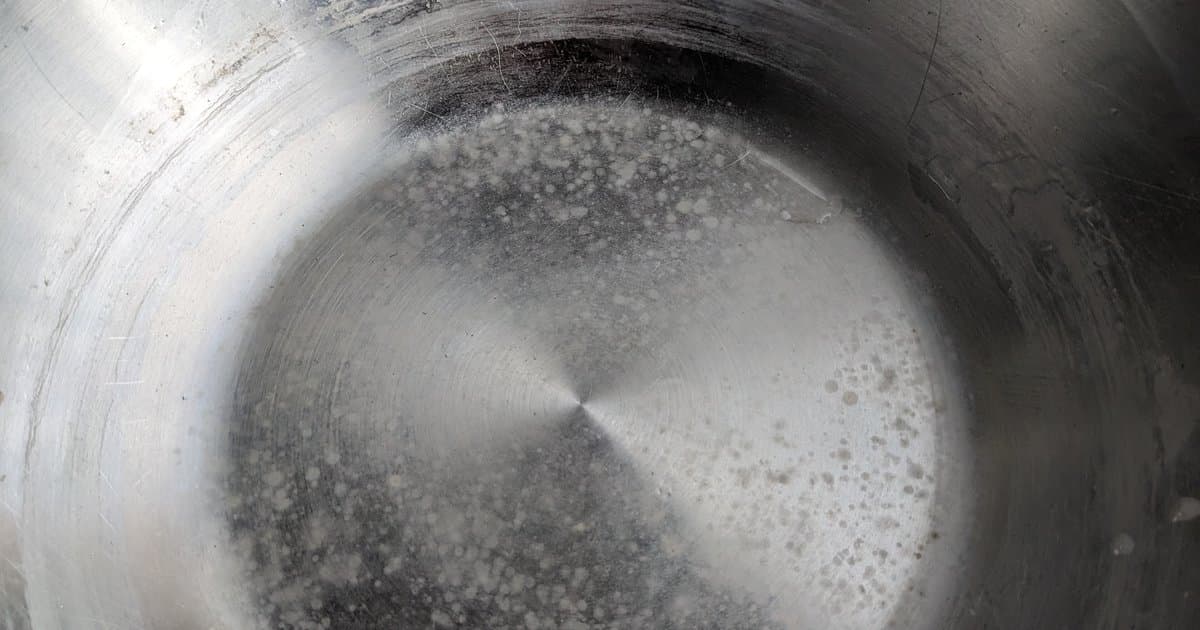
Three of the most common Tampa Bay area water complaints are white spots on glassware, white scale on faucets and showerheads, and a slimy or filmy feel at the shower. The first two are usually mineral hardness from the Floridan Aquifer or Tampa Bay Water's blended supply. The third is usually chloramine reacting with body oils plus soap residue from incomplete rinsing in hard water. This article walks through how to tell them apart, what to test, and how to fix each one without overcorrecting.
If you have lived in Tampa, Sarasota, Clearwater, Brandon, Wesley Chapel, or anywhere across the Tampa Bay metro for any length of time, you have probably run into one of these three water complaints. The annoying part is that the three causes overlap and the at-home tests for them are easy to misread. This article is the long version of the diagnostic conversation we have with most homeowners on the consultation call, written so you can self-diagnose first.
Complaint 1: White Spots on Glassware Coming Out of the Dishwasher
This is the easiest one to diagnose. White spots on otherwise clean glassware are almost always calcium carbonate, the dried-down residue of dissolved calcium and magnesium in your water. When water evaporates from a glass surface, the dissolved minerals stay behind as a fine white film. The hotter the rinse cycle and the slower the drying, the more visible the spot becomes.
The Tampa Bay area runs noticeably hard water by national standards. Tampa Bay Water's blended supply across Hillsborough, Pinellas, and Pasco counties typically delivers moderately hard to hard water at the tap (roughly 8 to 15 grains per gallon depending on which member utility serves you and which season). Lakeland, Plant City, Spring Hill, and most direct-Floridan-Aquifer addresses run 20 to 30 grains per gallon, which is unambiguously hard.
How to confirm it: Buy a hardness test strip (or call us for the free on-site test). Dip a strip in your tap water and read the color band. If the strip reads 7 grains per gallon or higher, hardness is the cause.
How to fix it: Add a rinse aid to the dishwasher (a short-term help, not a fix) and install an ion-exchange water softener for the real fix. A softener exchanges calcium and magnesium for a small amount of sodium, and the spots stop appearing within a week of install. Read our whole-house systems guide for the details on softener sizing.
What to test next if you already have a softener: If the softener is in place and you are still getting spots, the resin bed may have hit capacity (oversized softener regenerating too rarely), the softener may be undersized (exhausting before regeneration), or the salt level in the brine tank may have gotten too low to support regeneration. We troubleshoot all three on a service visit.
Complaint 2: White Scale on Faucets, Showerheads, and Around the Drain
This is the visible cousin of complaint 1. White scale on faucets is calcium and magnesium drying down onto the metal surface from chronic water contact. It builds up over months on the showerhead nozzles, on the kitchen faucet aerator, on the rim of the toilet bowl above the waterline, and around the bathtub drain.
Scale is the dominant marker of hard water in the Tampa Bay area. If you see new scale within three or four months of cleaning a fixture, you have meaningful hardness. The scale is also building up inside your water heater (where you cannot see it) and inside the heat-exchanger of your dishwasher and washing machine (also where you cannot see it). The visible scale on fixtures is the canary for what is happening to the appliances.
How to confirm it: The visible scale is the confirmation. If you want a number, the same hardness test strip from complaint 1 works.
How to fix it: The fix is the same as complaint 1: an ion-exchange water softener. Existing scale on fixtures cleans off with a vinegar soak or CLR. New scale stops forming within a week of softener install.
What to test next if you already have a softener: Same as complaint 1. Plus, check that the bypass valve on the softener is in the "service" position and not "bypass." Newer homeowners sometimes find their softener has been bypassed since the previous owner's last service visit and no one noticed.
Complaint 3: Slimy or Filmy Water at the Shower
This is the one that catches new Tampa Bay area homeowners off guard. The shower feels slimy. The soap won't rinse off your skin. Your hair feels filmy. This complaint has three possible causes and they require different fixes, so the diagnosis matters.
Cause A: Chloramine residue. Most Tampa Bay area utilities use chloramines as the primary disinfectant. Chloramines are more stable than free chlorine in distribution systems, which is why utilities favor them, but they are also harder to volatilize at the shower and they penetrate skin more readily. Chloramines can react with body oils and create a thin film that registers as "slimy" against the skin. If your slimy-feel issue is strongest at the shower and goes away within minutes of getting out, chloramine is a likely contributor.
How to confirm cause A: A free chlorine vs total chlorine test (we run this on the on-site test). If free chlorine reads low but total chlorine reads meaningfully higher (typically 0.5 to 4 mg/L), your utility is running chloramine. Tampa Bay Water and most of its member utilities are well-documented chloraminators; if you are on their system, you can assume chloramine is in play.
How to fix cause A: A whole-house catalytic carbon filter at the point of entry. Standard granular activated carbon (the kind in most refrigerator filters and many entry-level whole-house systems) does not fully remove chloramine at residential flow rates. Catalytic carbon is engineered for the chloramine bond and does. Pure Viva installs catalytic carbon as the standard in our Tampa Bay area whole-house builds. A shower-head filter rated for chloramine is a partial fix for renters or households not ready for a whole-house install. Read the chloramine deep-dive in our chloramines in Tampa Bay water article.
Cause B: Hard water plus soap residue. Hard water plus regular bar soap or body wash produces soap scum, which is the calcium and magnesium reacting with the surfactants in the soap to make an insoluble film. The film sticks to skin, the shower walls, and the curtain. People who move to the Tampa Bay area from a soft-water region notice this immediately; people who have always lived here often assume it is normal.
How to confirm cause B: Look at your shower walls and curtain. If there is a fine white-grey film at the waterline of the soap dish and the bottom of the curtain, that is soap scum. Hardness test strips will also confirm.
How to fix cause B: An ion-exchange water softener. Soft water lathers cleanly and rinses fully without leaving soap scum. Most homeowners notice within the first shower after install and cut their body-wash and shampoo dose roughly in half within a month.
Cause C: A new softener installed and you are still adjusting. Soft water genuinely feels different on skin than hard water. The "slimy" feel some new softener customers report is actually the absence of the thin mineral film that hard water leaves on skin, which most people have gotten used to as "the way water feels." After a week or two the brain recalibrates and the new feel registers as normal.
How to confirm cause C: Did you recently install a softener? If yes, give it 7 to 14 days. If no, this is not your issue.
How to fix cause C: Patience. There is no fix because the system is working as designed. Some homeowners do prefer slightly less aggressive softening; we can program a higher residual hardness setting on the softener if you want a small mineral residual back.
Get a free Tampa Bay water test
No-obligation on-site testing with hardness, chloramine, pH, TDS, and iron measured at your kitchen tap.
The Combined Diagnostic Path
In practice, most Tampa Bay area homes have all three issues stacked. The dishwasher leaves spots (complaint 1), the shower has scale (complaint 2), and the water feels slimy at the shower (complaint 3) because of chloramine plus soap scum. The fix is the combined whole-house stack: sediment, catalytic carbon for chloramine, and an ion-exchange softener for hardness. Add an under-sink reverse osmosis at the kitchen tap for drinking water and the household is fully treated for under $3,500 in most cases. Read our RO cost breakdown for the kitchen-tap side, and our whole-house systems pillar for the full-house side.
When to Call Pure Viva
The free on-site water test is the right starting point because the at-home strips give you a rough number but not a treatment plan. We measure hardness, free vs total chlorine (chloramine differentiation), pH, TDS, and iron, walk your house to look for scale and staining, and write a proposal sized to your real chemistry. The visit is free with no obligation. Call (941) 367-2354 or use the contact form.
Frequently Asked Questions
Are the white spots dangerous? No. Calcium and magnesium are not regulated as harmful contaminants and the white spots are aesthetic. The reason to address hardness is appliance longevity, soap performance, and personal preference, not health risk.
Can I just use a Brita pitcher? A Brita and most fridge-line filters use granular activated carbon, which removes free chlorine and improves taste but does not address chloramine or hardness. They are fine for drinking-water taste improvement, not for the white-spots or scale problem.
Will a salt-free conditioner work? Salt-free template-assisted crystallization systems can reduce visible scale at fixtures and inside water heaters, but they do not remove the calcium and magnesium and they do not improve soap lather. For soap performance and complete spot elimination, you need an ion-exchange softener.
Does the City of Tampa or Tampa Bay Water do anything about hardness? Tampa Bay Water and member utilities treat for safety and EPA compliance, not for hardness. Hardness is not regulated and is left to point-of-use or point-of-entry treatment.
How long until I notice the difference after install? Showers: that night. Dishwasher spots: within a wash cycle. Scale on fixtures: it stops forming within a week; existing scale needs a vinegar or CLR cleanup.
Should I shock my water heater after install? Optional. Some homeowners drain the heater to clear pre-softener water faster; most let normal use cycle through over a week.